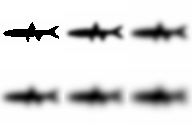
 Multi-resolution
In biological vision systems, particularly referring to primates, broadly
speaking the light sensitive elements on the retina are distributed in a
non homogeneous way so that a central area is densely covered while the
periphery has a smaller number of sensitive elements. Many authors
argued that this acuity distribution on the retina provides a hardwired
implementation of scale invariant analysis for object recognition. Moreover,
in this way the subject perceives a global view and then only the
interesting/relevant components of such view are observed by redirecting
the eye so as to expose the fovea (central area having the maximum
resolution) to analyze those components.
This mechanism may also switch between different resolution levels (excluding
the extremes); such switching also reflects a hypothesis-testing modality
which is typical of a biological reasoning process that maximizes the
use of limited physical resources. At each analyzed level, the total amount
of processed information is constant since the number of picture elements
which are handled is approximately the same regardless of the image
resolution.
Multi-resolution representations have been proposed for object recognition
since they provide the framework for emulating the focus of attention
strategy typical of biological systems. In the Laboratory the problem of
matching two-dimensional objects described by multi-resolution
representations have been considered. Each object is modeled as a tree,
in which nodes correspond to boundary segments and arcs connect nodes
at successive levels of resolution. The children of a given node
describe the structural change occured to a given segment between consecutive
resolution levels. A two-dimensional object can be recognized as an instance
of a model possibly rotated and translated, if the corresponding tree can
be mapped into the tree.
Back to IST Home Page