 Distributed Perceptive SystemsDistributed Perceptive Systems
Biological inspiration has suggested a number of alternative approaches, whose basic tenet is the tight integration of perception and planning in a single closed control loop, implemented as a collection of cooperating units. Each unit is specialized in the execution of a single action in the behavioural repertoire of the systems.
As it is common with active behaviour, within this framework perception should be described in terms of primitive actions, which are combined to build complex sequences. Perceptive actions, like foveation or pursuit movements, modify the relation between the agent and the environment in the same way physical actions involved in navigation do. Just as active behaviour modifies the environment to reach a desirable state, perceptive behaviour modifies the internal state and the posture of the agent to ease the acquisition of useful information.
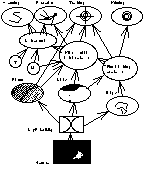
A simple access-control system is currently being implemented as a testbed for the proposed model. The goal of the system is to fixate and track human faces in an image sequence acquired by a static wide-field camera. In order to test the concept of perceptive action, we deliberately excluded physical control issues, limiting "effectors" to the control of the focus of attention within the static field of view. Possible action modules include scanning, foveation, tracking and warning. Planning is carried out by a free-flow hierarchical network whose nodes compute activation values for the behavioural modules, after taking into account likelihood values evaluated by low-level modules and discount factors due to temporal and operational uncertainties.